
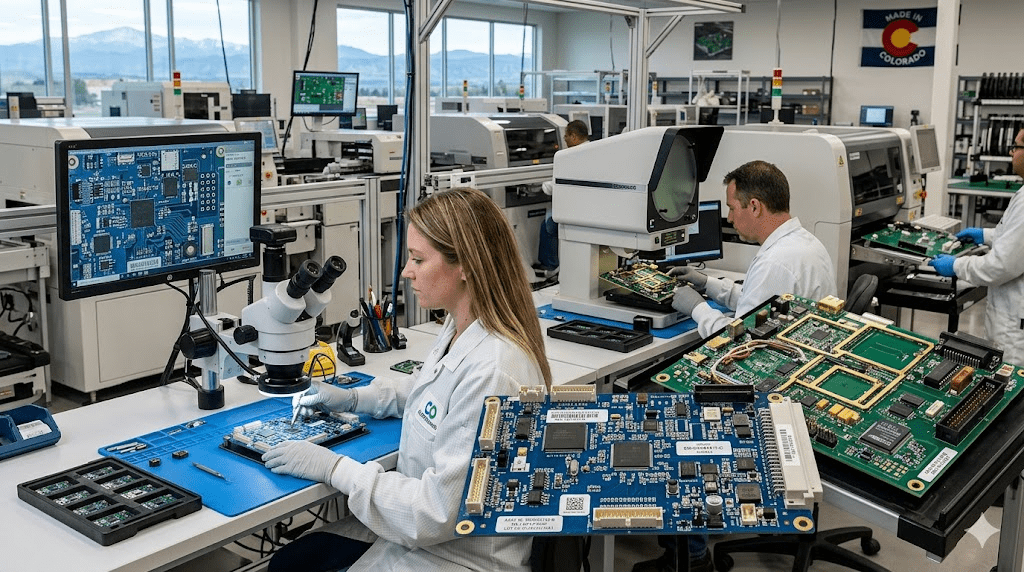
Traceability is one of those words that gets used frequently in manufacturing but is not always clearly defined. For companies in regulated or high-stakes industries, the difference between adequate traceability and genuine end-to-end traceability can be the difference between passing an audit and losing a contract, or worse, having to manage a field recall without the data needed to identify which units are affected.
If you are sourcing PCBA assembly in Colorado for a medical device, an aerospace system, or an industrial critical environment application, you need to understand exactly what traceability looks like in practice, not just as a checkbox on a certification form. This article breaks it down in plain language.
What Does Traceability Actually Mean in PCBA Assembly?
Traceability in PCBA assembly means the ability to reconstruct the complete history of a specific unit or batch. That history includes every component used, where that component came from, when it was installed, who installed it, which version of the work instructions was in effect at the time, what test results the board produced, and what happened at every stage of the production process.
True traceability means that if a field failure occurs months or years after delivery, you can identify the root cause by looking at manufacturing records. You can determine whether the failure is isolated to a specific batch of components, a specific shift, a specific process step, or whether it is a systemic issue requiring broader action.
For industries like medical, aerospace, and industrial and critical environment applications, this level of documentation is not optional. It is required by the standards your products must meet to be sold and deployed.
What Certifications Drive Traceability Requirements for PCBA Assembly Colorado?
Different industries are governed by different standards, and each standard creates specific traceability requirements. Here is what you need to know about the three most relevant certifications for Colorado PCBA assembly in regulated industries.
What Does ISO 13485:2016 Require for Medical Device PCBA Traceability?
ISO 13485:2016 is the quality management standard for medical device manufacturing. It requires manufacturers to maintain device history records that document the complete production history of each finished medical device. For PCBA assembly, this means:
- Lot and serial number tracking for all components
- Documentation of all assembly steps with reference to approved work instructions
- Records of all inspection and testing activities, including pass/fail results
- Documentation of any nonconformances and their disposition
- Identification of the personnel involved in critical assembly steps
- Records sufficient to support a product recall or field safety corrective action if required
The Electronic Device History Record (DHR) is the practical manifestation of these requirements. A qualified medical device PCBA assembly partner will generate a complete DHR for every unit or batch they build.
What Does AS9100D Require for Aerospace PCBA Traceability?
AS9100D is the quality management standard for aviation, space, and defense. It places even more emphasis on configuration control, meaning the ability to confirm exactly which version of a design was built and which components were used. Traceability requirements under AS9100D include:
- Component traceability to the original manufacturer and lot
- Documentation of any approved supplier deviations or waivers
- Configuration identification and change control records
- First article inspection documentation for new or changed designs
- Counterfeit parts avoidance records demonstrating component authenticity
- Test and inspection records at each stage of build
The counterfeit parts requirement deserves special attention. In aerospace PCBA assembly, the risk of counterfeit electronic components is a well-documented industry concern. A qualified AS9100D-certified partner maintains component traceability specifically to demonstrate that every part used in an aerospace build came from an authorized source.
What Does ISO 9001:2015 Require for Industrial PCBA Traceability?
ISO 9001:2015 is the foundational quality management standard that applies across industries. While it does not prescribe the same level of unit-level traceability as the medical and aerospace standards, it does require manufacturers to control and document their production processes in a way that allows nonconforming product to be identified and contained.
For industrial and critical environment applications, this means a PCBA assembly partner operating under ISO 9001:2015 will have documented work instructions, inspection and test records, nonconformance management processes, and the ability to identify affected lots if a quality issue is discovered.
Vergent Products holds all three of these certifications: ISO 9001:2015, ISO 13485:2016, and AS9100D. This means they can serve clients across medical, aerospace, defense, and industrial markets from the same facility in Loveland, Colorado, with the traceability infrastructure each standard demands.
What Does a Paperless Manufacturing Execution System Do for Traceability?
One of the most important infrastructure decisions an EMS partner can make for traceability is whether to run paper-based or paperless documentation systems on the production floor.
Paper-based systems create inherent traceability risks. Documents get misfiled. Updated versions may not reach every workstation. Handwritten entries are harder to search and analyze. Signatures and dates can be difficult to verify. When a quality event occurs, reconstructing the history of a specific unit from paper records can be extremely time-consuming.
A paperless MES addresses these risks by capturing production data electronically in real time. Every scan of a component barcode, every completed assembly step, every test result, and every inspection outcome is recorded automatically in a database that is searchable and auditable.
Vergent Products operates a state-of-the-art paperless MES as part of their contract manufacturing services. This system is designed to prevent errors before they occur and to support complete traceability for every build. It also enables automated serialization and electronic Device History Records, which are critical capabilities for medical and aerospace clients.
What Does Component-Level Traceability Look Like on the Production Floor?
For regulated industries, component-level traceability means more than just knowing which BOM revision was used. It means being able to link each individual component on a specific board to the lot it came from and the supplier who shipped it.
In practice, this requires barcoding or labeling components at receiving, maintaining lot segregation throughout the warehouse and kitting process, scanning components at the point of use during assembly, and linking that scan data to the serialized unit being built.
When this is done correctly, a manufacturer can answer the question: which specific units were built using components from lot number XYZ, and where are those units now? That question is often the first thing asked in a field failure investigation or recall situation.
Vergent Products supports automated serialization and data sharing as part of their final product assembly services. Their contract manufacturing capabilities include Electronic DHR and configure-to-order options, giving clients the traceability depth their industries require.
How Does Testing Contribute to Traceability for PCBA Assembly?
Test data is an essential part of the traceability record. For medical, aerospace, and industrial builds, it is not enough to know that a board passed testing. You need to know what was tested, at what parameters, with what equipment, on what date, and whether any failures were observed and how they were dispositioned.
A comprehensive testing portfolio that generates and retains detailed test records is a traceability asset, not just a quality gate. If a field failure points to a specific failure mode, having detailed test records for every unit allows you to identify whether that failure mode was present at the time of manufacture and escaped detection, or whether it developed in the field after delivery.
Key testing capabilities that support traceability in PCBA assembly include:
- 100% automated optical inspection (AOI) with stored results
- In-circuit testing with parametric data capture
- Functional testing with pass/fail and measured values recorded
- Extended test and burn-in with time-stamped records
- Environmental chamber testing with calibrated test equipment records
Each of these test types generates data that becomes part of the unit’s history record. A manufacturer who performs these tests but does not retain the data is providing much weaker traceability than one whose MES captures and archives every result.
How Does Traceability Differ Across Medical, Aerospace, and Industrial Markets?
What Does Traceability Look Like for Medical Device PCBA Builds?
Medical device traceability is focused on the complete Device History Record and the ability to support a field safety corrective action. Every unit must be traceable to its exact build configuration, including software and firmware versions. The manufacturer must maintain records for the life of the device, which for implantables can be decades.
For Colorado companies in the medical space, Vergent Products’ medical device manufacturing capabilities are built around ISO 13485:2016 requirements and the documentation needs of regulated medical products.
What Does Traceability Look Like for Aerospace PCBA Builds?
Aerospace traceability emphasizes configuration control and counterfeit parts prevention. Every component must be traceable to an authorized source. Build records must support first article inspection documentation. Changes to the design or build process must go through formal change control with records retained.
Vergent Products’ aerospace manufacturing services are underpinned by AS9100D certification, which drives the counterfeit parts avoidance and configuration control practices that aerospace clients require.
What Does Traceability Look Like for Industrial and Critical Environment Builds?
Industrial and critical environment traceability focuses on lot containment and process control. If a quality issue is identified in a deployed system, the manufacturer must be able to identify all other units potentially affected and contain the problem. This requires lot-level traceability at minimum, and unit-level traceability for the highest-criticality applications.
Vergent Products’ capabilities in industrial and critical environment manufacturing are designed to support the documentation requirements that critical system clients expect.
